
Grant County Unclaimed Money Records
Grant County Unclaimed Money searches work best when you start with the county treasurer, then move to the court and probate offices if the record is not purely tax-related. The treasurer is the county's money manager and tax collector, and the office keeps separate accounts for taxes, redemptions, and general funds. That makes it the natural first stop when a payment, refund, or county balance does not line up. If the money belongs somewhere else, the county's court and probate offices give you the next local path before you turn to Wisconsin DOR.
Grant County Unclaimed Money and Treasurer
Grant County Treasurer is the office that anchors most Grant County Unclaimed Money searches. Carrie Eastlick is the elected treasurer. The office is at 111 S. Jefferson Street, P.O. Box 430, Lancaster, WI 53813-0430. The phone number is 608-723-2604, the fax is 608-723-5636, and the email is ceastlick@co.grant.wi.gov. Office hours are 8:00 a.m. to 4:30 p.m. Monday through Friday.
The treasurer is a constitutional officer elected every four years, and the office's duties sit under Wis. Stat. 59.25 and Chapter 70. That matters because the office does more than collect a bill. It receives and pays out county money, keeps separate accounts for taxes, redemptions, and general funds, prepares tax settlements for the Department of Revenue, pays state fees for licenses, fines, forfeitures, and real estate transfer returns, deposits jail assessments, invests county funds, and manages tax deeded lands.
The office also keeps use value changes, MFL and PILT payments, and records that are open and available to the public. Services include processing tax payments and general receipts, approval of plats and notice to cut timber, and certification of lottery credit applications. That public access is useful when a resident is trying to match a payment to the right parcel or a county-held balance to the right tax year.
For Grant County Unclaimed Money, the treasurer is the best first call because the office controls the county side of the money trail. If the money is still local, the treasurer can usually explain why. If the office says the record belongs elsewhere, the search can move with more confidence and less guesswork.
Grant County Unclaimed Money Images
Grant County Treasurer is the office that keeps the county tax and money record together.
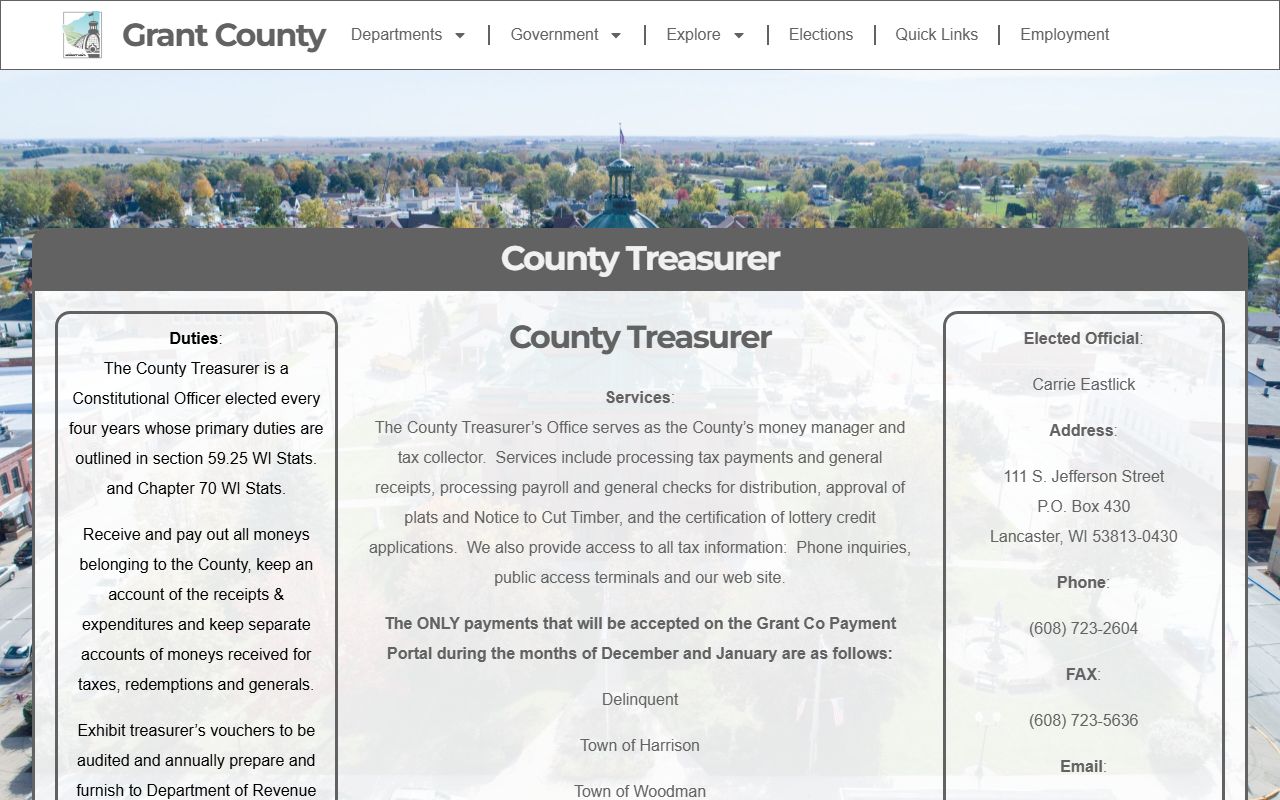
That image is the cleanest first stop because the treasurer is the office that handles county money, tax settlements, and public receipts.
Grant County Clerk of Court is the county court-side office that keeps the legal record in view.
That image fits the court side of the search because court fees, fines, and judgments can create money trails that do not stay with the treasurer.
Grant County Register in Probate is the local office for probate and related court matters.
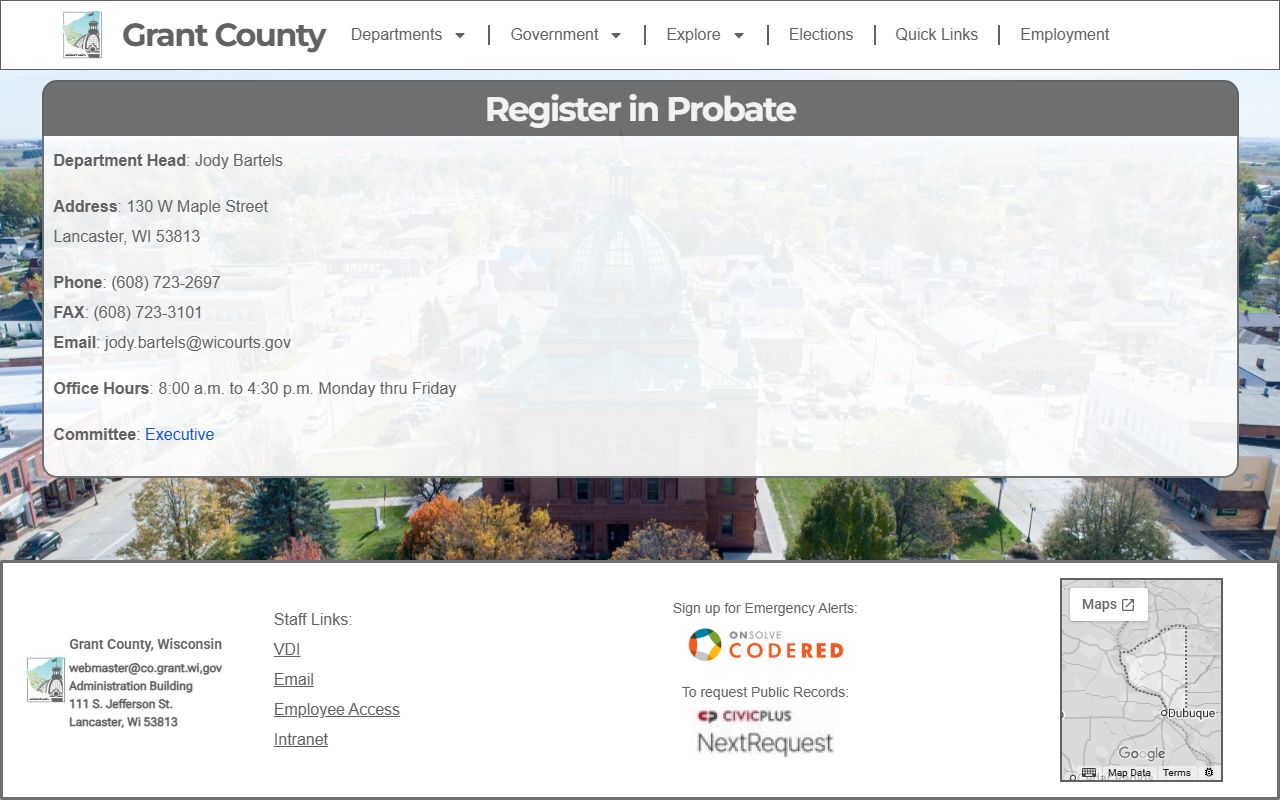
That image helps when the balance belongs to an estate or another probate file instead of a tax account.
Grant County Court and Probate Records
Grant County Clerk of Court is the county's court-side record stop. The official county directory lists the Clerk of Courts at 130 W. Maple Street, P.O. Box 110, Lancaster, WI 53813, with phone 608-723-2752 and fax 608-723-7370. The directory says the office serves all courts, handles small claims, maintenance and support payments, keeps court papers, records names of parties in every civil action, keeps criminal records and judgment and lien dockets, and collects fees on civil actions, judgments, and fines.
That is exactly the kind of record that can look like unclaimed money later. A fee payment may sit in the court file. A judgment balance may need a follow-up. A docketed matter may still be open. If the clerk says the money belongs to the court, the search stays with the court record instead of drifting into a general state account too soon.
Grant County Register in Probate is the same county's probate office. Jody Bartels heads the office. The address is 130 W Maple Street, Lancaster, WI 53813. The phone number is 608-723-2697, the fax is 608-723-3101, and office hours are 8:00 a.m. to 4:30 p.m. Monday through Friday. The office serves probate, guardianship, mental health, and juvenile court matters.
That matters for Grant County Unclaimed Money because an estate or probate file may still control the funds. If a claim is tied to a decedent, a guardian, or a mental health or juvenile matter, the Register in Probate is the office that tells you whether the local file still controls the money and what proof the court will need.
Grant County Tax Records
The tax side of Grant County Unclaimed Money is strong and specific. The treasurer keeps separate accounts for taxes, redemptions, and general funds. It prepares annual tax settlements for the Department of Revenue, pays state fees tied to licenses and forfeitures, and manages tax deeded lands. Those are not abstract tasks. They are the mechanics behind the county money trail, and they show why tax records are often the first place a missing balance appears.
The county also says the treasurer's information is open and available to the public. That public access matters when you are trying to match a parcel, a payment, or a redemption amount to the right year. If the first installment or the full payment was due and the amount was not paid, the account can move into delinquency. The treasurer's records are the place to see that before you file a claim anywhere else.
The office also records use value changes, MFL and PILT payments, and other tax-related adjustments. Those details are easy to miss if you only look for a generic unclaimed funds list. In Grant County, the tax trail itself can explain why the money is there, and the treasurer is the office best positioned to explain it.
If the money began as a tax payment, a redemption, or a county fee, keep the search with the treasurer until the office says the record is not local.
Grant County Claim Steps
The cleanest Grant County Unclaimed Money process is simple. Start with the treasurer for tax payments, county receipts, and general money questions. If the balance turns out to be court-related, move to the Clerk of Court. If it belongs to an estate or probate file, move to Register in Probate. That sequence keeps the claim tied to the office that actually controls the money.
If you are calling the treasurer, keep the tax bill, parcel number, payment date, or refund information close by. If you are calling the clerk, keep the case number, docket information, or judgment details close by. If you are calling probate, keep the decedent name, estate file, or guardianship matter close by. Small details speed up the local search.
Because the treasurer's information is public, a lot of Grant County records can be confirmed before a claim is filed. That is useful when the question is whether a payment was received, whether a balance is still county-held, or whether the money belongs in a court file. A focused local review is usually the fastest route to the right office.
If the county offices say the money is not local, the state database becomes the next step. Until that point, the county side should stay the focus.
Wisconsin Unclaimed Money Search Help
The Wisconsin Department of Revenue is the statewide fallback when Grant County Unclaimed Money is not held by the county offices. DOR is the right place to search after the treasurer, clerk of court, or Register in Probate says the record is not local. That keeps the claim honest and prevents paperwork from going to the wrong custodian.
The Wisconsin DOR unclaimed property FAQ explains the state custody role. How to claim property walks through the filing process. DOR says you can search by name or property ID, save a draft, and resume later, but the confirmation code only stays valid for 60 days. That makes it worth saving the code right away if you pause the claim.
Relationship types and documents needed and acceptable documents explain the proof the state expects from owners and heirs. Those pages are the right fit only after the county office says the record is not local. They help you file with the right relationship and the right documents the first time.
The state search is important, but it is not the first move in Grant County. The local offices decide which record path is real. DOR is the next step when the county record ends.
Wisconsin Unclaimed Money Statutes
Wisconsin's statutes explain the framework behind the county and state steps. Wis. Stat. 59.25 and Chapter 70 are the local statutes the Grant County Treasurer cites for its constitutional role, money handling, and tax work. That legal structure is why the treasurer can receive and pay out county money, maintain separate accounts, and prepare settlements for the Department of Revenue.
For statewide unclaimed property, Wis. Stat. 177.01 defines the core terms. Wis. Stat. 177.0501 describes the holder notice duty, and Wis. Stat. 177.0903 explains how an owner files a claim. Those sections matter because they show why a county-held tax or court record is not the same thing as state-held abandoned property.
When the local office and the state law are read together, the process stays clear. The county decides whether the record is local. The statutes explain how the state claim works if the money has already left county control.
That is the best way to handle Grant County Unclaimed Money. Keep the county record first, then use the state rules only when the county says the money belongs elsewhere.