
Waukesha Unclaimed Money Records
Waukesha Unclaimed Money searches usually end at the county treasurer because Waukesha is the county seat and the county holds the local unclaimed funds process. That is useful for city residents who know there is money somewhere but do not know whether the record came from a county payment, a court refund, or a tax issue. The county office gives you the official contact point, the claim form, and the tax tools that help show where the money went. If the trail starts in the city and ends in county custody, this is the page that keeps the route clear.
Waukesha Unclaimed Money and the County Treasurer
City residents use the same county treasurer office that serves the rest of Waukesha County. The Waukesha County Unclaimed Funds page is the local route, and the county treasurer office is located at 515 W Moreland Blvd, RM AC 148, Waukesha, WI 53188. Office hours are Monday through Friday from 8:00 AM to 4:30 PM, and the phone number is 262-548-7029. The county handles the unclaimed funds process there, not at a city desk.
The county treasurer page explains that the office manages county funds, collects property taxes, and maintains tax billing and collection history records. That matters for city residents because a city payment or refund can still end up in county hands when the record is tied to a county department or a municipal treasurer. The county is where the trail usually becomes official. If you know only that a Waukesha payment was lost or never cashed, the county treasurer page is the starting point that makes the search manageable.
The county site also points out the drive-up drop box and the USPS postmark change notice, which are both useful for city residents trying to match a payment date. A payment that went through the box by 7:30 a.m. can be dated to the prior day, and a mailed payment may not be postmarked when you expect because of the USPS change. Those details can affect whether the money was timely, late, or eventually turned into a claim.
The county unclaimed funds page is shown at Waukesha County Unclaimed Funds, which is the official city-to-county route for a claim search.
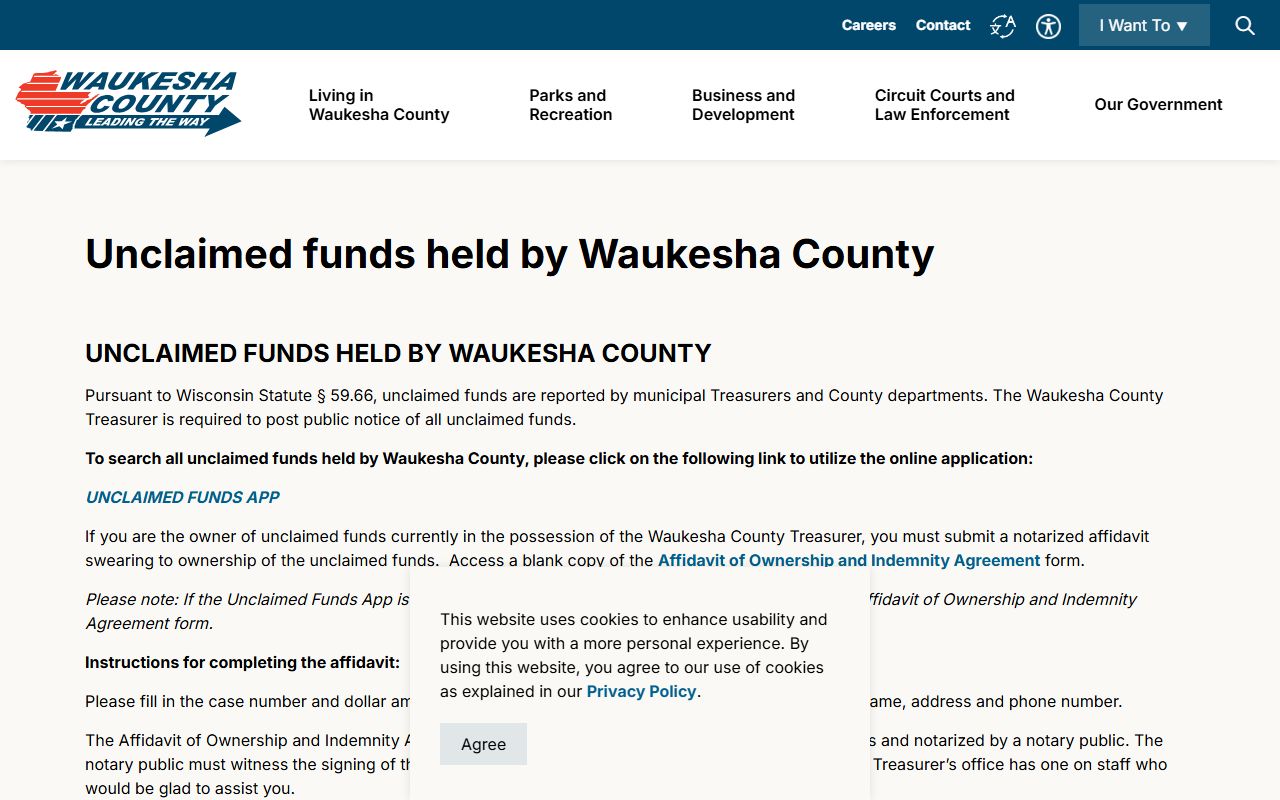
That page is the best evidence that city residents do not need a separate city unclaimed money office. The county treasurer is the one holding the process, and the county's pages are what you use to get there.
How Waukesha Unclaimed Money Claims Work
The county's claim page explains the same process in more detail. On Waukesha County Unclaimed Funds, the county says you can search all unclaimed funds held by Waukesha County through the official Unclaimed Funds App. Once you find a match, the county asks for a notarized Affidavit of Ownership and Indemnity Agreement. The affidavit is the form that turns the search result into a real claim.
The county says the affidavit should include the case number, dollar amount, claimant name, address, and phone number from the published notice. A copy of the claimant's driver's license or picture ID must also be included. If the claim is for a business, the county wants a copy of the business card too. Those documents let the treasurer office tie the claim back to the original record instead of relying only on a name match.
Waukesha County notes that most of the information can autofill from the Unclaimed Funds App, which is a small but important detail. It reduces typing and helps keep the claim consistent with the notice. The county also says the form must be signed and notarized in front of a notary public. Notaries are available at most banks, and the treasurer's office has one on staff. That makes an in-person stop practical if you are already near the courthouse area.
Once the affidavit and identification are received, the county says it takes approximately 30 days to receive a check. The check is mailed to the address listed on the affidavit and is made payable to the same person or entity as the original check. That language is important because it tells city residents that the county is not issuing a new payment from scratch. It is reissuing the original money to the right owner after proof is verified.
This is the local claim path that Waukesha residents should expect when the money is under county custody. It is straightforward, but it still depends on the right documents and a notarized statement. That keeps the process close to the original record and protects both the county and the claimant.
For city residents, the main practical point is that the unclaimed funds app and affidavit are the center of the process. If you have the published notice, the money can usually be traced back to the right office. If you do not, the county app gives you the search entry point that the city itself does not provide.
The county process is also useful when the money came from a municipality or court in the area and then moved into county custody. Waukesha City residents often start with a simple question and end with an affidavit because the county is where the final claim lives.
The county keeps the office address and the mailing address the same so the paperwork can move without confusion. That helps a resident who wants to walk the claim in or mail it without changing offices midstream.
The claim page is the proof that city residents use the county level, not a separate city process. That makes the route short and official, which is exactly what a local unclaimed money search needs.
Waukesha Tax and Court Records
City residents often need tax or court records before they can finish an unclaimed money search, and the county has both. The Waukesha County Tax Search Portal lets you search by parcel number, address, or owner name. It also shows tax payment history and current year tax information. That is useful when a city resident is trying to figure out whether a payment was posted, returned, or applied to the wrong parcel.
The county circuit courts page adds another layer. On Waukesha County Circuit Courts, the county provides court record access through WCCA On-Line Records Search, court filing and fee information, local court rules, and transcript procedures. The courthouse is at 515 W Moreland Blvd, and the hours are Monday through Friday from 8:00 AM to 4:30 PM. If the money came from a court payment or refund, those records can help explain where it went.
The payment and refund information page is especially relevant when a city resident is tracing a court-related payment. It explains payment by phone, mail, and online, and it notes that bail refunds are made after disposition of the case to the person who made the payment unless a judge orders otherwise. It also explains in-person payment rules, payment plan details, and collections follow-up. That is the kind of context that can turn a vague missing-money question into a specific county record search.
For city residents, the tax portal and the circuit court pages are the two most useful supporting records. One shows the property side of the trail, and the other shows the court side. Together they help explain whether the money belongs in a tax file, a court file, or an unclaimed funds notice.
The county court pages also show why Waukesha residents do not have to guess where to go. The courthouse, the payment office, and the treasurer all sit under the same county roof. That makes it easier to move from a court question to a claim question without leaving the official site set.
If the city question started with a citation, a refund, or a payment plan, the county court pages help you understand the money path before it becomes an unclaimed funds issue. The same applies to property taxes. The tax portal gives the current-year picture and the history behind it.
Those pages are also useful when a resident needs to know whether a balance is still active or whether it has already moved into county custody. That is a common reason people think they have lost money when the record is actually sitting in another office.
City residents can use these county records to distinguish a live payment problem from an unclaimed funds claim. That distinction keeps the search clean and prevents the wrong office from becoming the first stop.
Wisconsin Unclaimed Money Rules for Waukesha Residents
The county process still sits inside the state framework. The Wisconsin Department of Revenue Unclaimed Property home page is the statewide search tool when the money is not held by Waukesha County. The how-to-claim page explains how to search by name or property ID, add property to a claim, and attach documents that prove ownership. That state route matters when a city resident learns the county does not hold the money after all.
The DOR also explains the claim relationships and documents. The relationship types page covers owners, heirs, guardians, and personal representatives, while the acceptable documents page explains what proof can travel with the claim. Government ID, proof of address, and documents showing authority are often part of the file. The state wants the claim to match the relationship to the property, not just the claimant's name.
Wisconsin statutes give that process its shape. Wis. Stat. § 177.01 defines the key terms used by DOR. Wis. Stat. § 177.0501 covers the holder's notice duty, and Wis. Stat. § 177.0903 explains how an owner files a claim on the prescribed form. Waukesha residents do not need a law school reading to use the rules, but the statutes explain why the county and the state both ask for proof.
After the claim is filed, the DOR after-you-file page explains what happens next. DOR usually needs up to 12 weeks to review a claim, and approved payments are typically issued soon after approval. If the office needs more information, the claim can stay open until the missing piece arrives. That is why the county claim and the state claim both depend on accurate identity documents and a current mailing address.
For Waukesha residents, the practical rule is simple. Use the county treasurer first when the money appears to be local. Use DOR when the county says the money belongs to the state program. The pages on this site keep that split clear so you do not waste time at the wrong counter.
The county seat relationship makes that even more practical. A city resident can walk to the same county office that handles the unclaimed funds claim, then move to the state page only if the county search comes up empty. That gives the process a clean order and keeps the work grounded in official records.
That is the real value of the Wisconsin rules for a city resident. They explain why the county office, the state office, and the city records can all be part of the same search without being the same search.
When the money is local, the county closes the loop. When it is statewide, DOR does. The rules tell you which one to use, and the Waukesha pages show you how to get there.