
Milwaukee City Unclaimed Money Search
Milwaukee unclaimed money is not held in just one place. Some records belong to the City of Milwaukee Employees' Retirement System, some belong to Milwaukee County, and some belong to the Wisconsin Department of Revenue. That split matters because each source uses a different search path and a different claim process. If you worked for the city, had a local court or tax issue, or are searching a statewide account, the first step is to match the record to the right office. Once you know the holder, the rest of the process becomes much easier.
Milwaukee Unclaimed Money Sources
The City of Milwaukee page is important because it covers retirement-related property, not the same county-held funds that show up in Milwaukee County Treasurer publications. Milwaukee residents often need to check all three sources. City retirement history can lead to CMERS, county court or local government money can lead to the Milwaukee County Treasurer, and bank or insurance property can lead to the Wisconsin DOR database.
That separation keeps a Milwaukee search accurate. If a former city employee is looking for a final benefit payment, the city retirement page is the right place. If the money came from a county case, a jury payment, or another local government account, the county treasurer handles it. If the property came from a financial institution or another statewide holder, the DOR holds it under Wisconsin's unclaimed property program.
For a broad Milwaukee search, start with the source that best matches the record type, then move outward only if you do not find a match. That approach prevents you from filing the wrong claim in the wrong office and saves time when the paper trail is older or incomplete.
City ERS Unclaimed Money
The City of Milwaukee Employees' Retirement System lists unclaimed property that has been available for payment but not paid to the owner for one year from the date it first became payable. According to the research notes, that includes uncashed benefit checks, unclaimed account balances for prior city employees who did not earn enough qualifying time to vest in the ERS, and final payments that were not claimed by a beneficiary. The published unclaimed property list is current as of 12/31/2025, so it gives city employees and beneficiaries a concrete place to start.
If you think the ERS may be holding your money, the page says to contact ERS for instructions on how to claim the benefit. That is the key difference between a city retirement payment and a county fund. CMERS is not a general city hall intake desk and it is not the Wisconsin DOR. It is the retirement system that controls the benefit record, so the claim should follow the ERS process rather than a county or state route.
The official CMERS unclaimed property page below is the right starting point for city retirement-related unclaimed money because it describes exactly which payments can appear on the list and how the retirement system wants claimants to proceed.
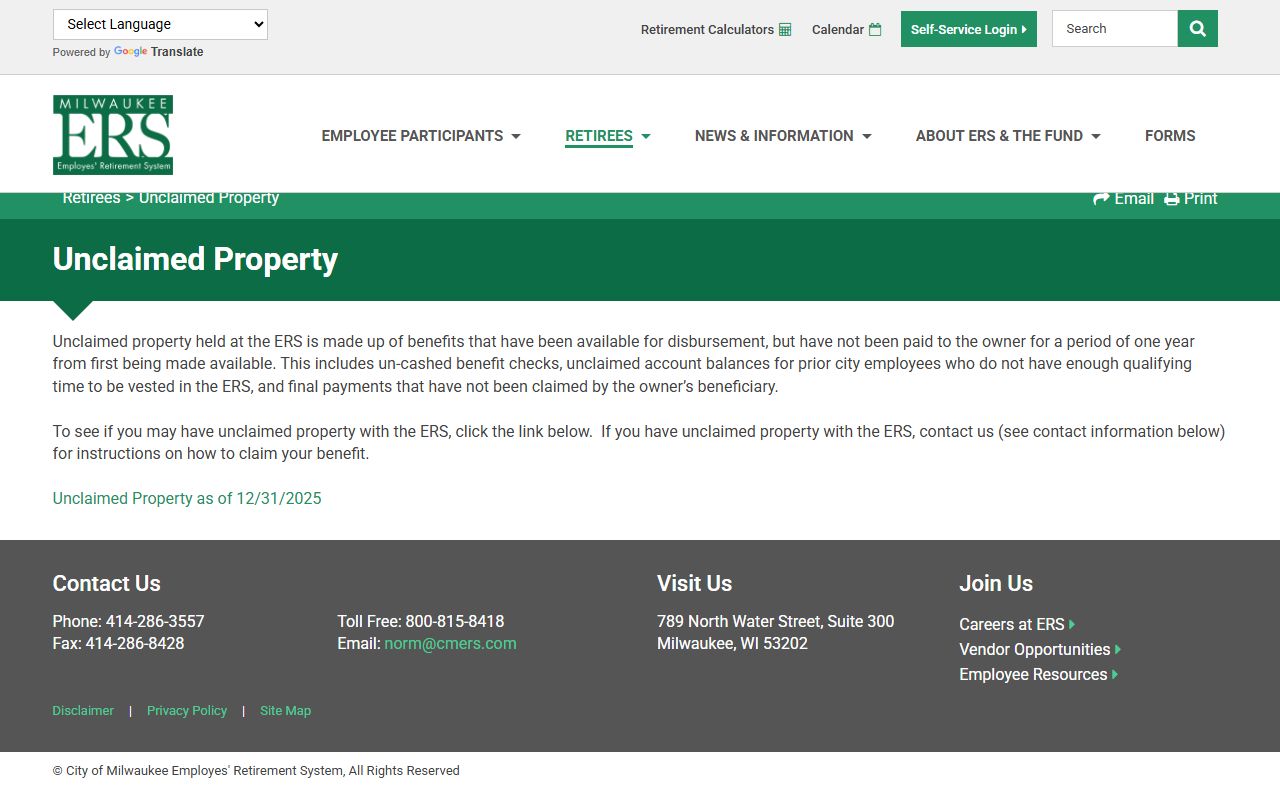
Use that source first if the money is tied to City of Milwaukee retirement or beneficiary payments, since the ERS list is specifically built for those accounts.
Milwaukee County Funds
Milwaukee city residents also need the county path because Wisconsin law treats local municipal and court funds differently from statewide unclaimed property. The Wisconsin Department of Revenue says money held by a local municipality or court is held by the County Treasurer on behalf of the courts and municipalities in that county, not by DOR. For Milwaukee, that means some records still route through the county office even if the person lives in the city.
The Milwaukee County Treasurer handles county-held unclaimed funds, delinquent property taxes, and other finance records. It also publishes annual lists and asks claimants to use the official claim form for each amount. If you are a Milwaukee city resident and the record came from a local court, a jury payment, a sheriff-related account, or another county source, the county treasurer is the office that matters most.
The county courthouse location, hours, and claim procedure are worth keeping in mind even on a city page because the city and county systems overlap in everyday use. A Milwaukee resident who starts with the city, then learns the money is county-held, will usually need to move to the Treasurer's office at 901 N. 9th Street, Room 102, Milwaukee.
That county office is also the place to verify whether a fund belongs to the Treasurer or another Milwaukee County department. That step matters because some funds are held by the Register of Deeds, and the claim instructions tell you to match the holding department before you submit anything.
Wisconsin Unclaimed Money Search
The Wisconsin Department of Revenue is the statewide repository for unclaimed property from banks, insurers, utilities, and many other holders. The DOR says the search is free and the state holds property indefinitely until it is claimed by the owner or the correct heir. That makes the DOR search a necessary second step for many Milwaukee residents, especially when the record is not clearly city-held or county-held.
Wisconsin's claim process is straightforward once you know the holder. The DOR asks you to search for the property, choose the relationship type, and submit the documents that prove your identity or authority. The state also lists acceptable documents and explains that you can claim the property without paying a fee. If you are searching for a deceased relative, the DOR instructions and statutes help explain when an heir claim, a transfer by affidavit, or a court order is required.
Helpful statewide links include the Wisconsin DOR Unclaimed Property home page, the claim instructions, the FAQ page, and the acceptable documents page. The legal framework is in Wis. Stat. 177.0903, Wis. Stat. 177.0501, and Wis. Stat. 177.01.
How to Check Milwaukee Records
The easiest way to handle Milwaukee Unclaimed Money is to work in order by holder. Start with CMERS if the money came from a city retirement record or benefit. Move to the Milwaukee County Treasurer if the record came from a local court, county payment, or other county-held fund. Then check the Wisconsin DOR database if the source looks like a bank, insurer, utility, or other statewide holder.
That sequence is better than checking random databases because it matches the way the records are actually held. City retirement money stays with the city retirement system. County money stays with the county treasurer. Statewide unclaimed property stays with DOR. Each office has different contact points, different claim forms, and different proof requirements, so the source tells you how to move forward.
If you are still unsure which office holds the money, review the name on the list and the description of the source before filing. A former city employee with an old benefit balance should not use the county claim form, and a county tax refund should not be sent to CMERS. The holder determines the claim path, and Milwaukee searches go faster when the holder is identified first.
Claiming Milwaukee Funds
For city retirement funds, follow the ERS instructions on the CMERS page and ask the retirement system how to claim the benefit. For county-held funds, use the Milwaukee County Treasurer's official claim form and follow the notarization rule. For statewide property, use the Wisconsin DOR online claim process and upload the documents the claim type requires. Each path is valid, but each one answers a different kind of Milwaukee money question.
If you are preparing a claim for a deceased person, read the DOR claim guidance carefully and make sure the documents match the relationship type you choose. The same is true for county claims, especially when a person is claiming on behalf of someone else or needs to prove authority to receive the funds. The fastest claims are the ones that match the holder, the owner, and the document set from the start.